Did You Know?
At their peak in 1958, there were over 4,000 drive-in theaters operating across the United States — one for roughly every 45,000 Americans.
The Rise and Fall of the American Drive-In Theater
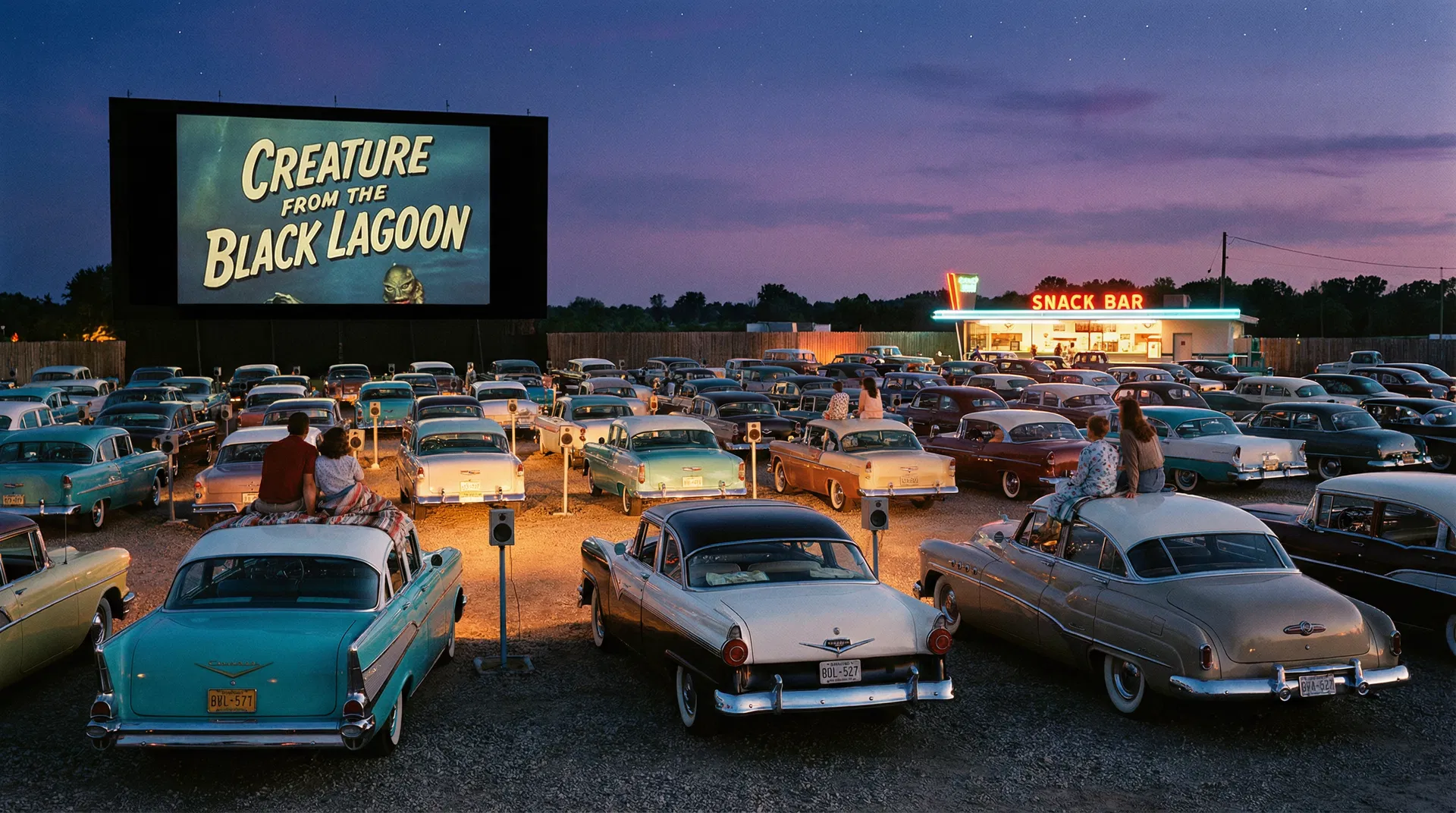
On a warm summer evening in 1958, more than 4,000 drive-in theaters dotted the American landscape, their towering screens glowing like beacons against the twilight sky. Families packed station wagons with blankets and snacks, teenagers cruised in with dates, and children played on swings beneath the stars while waiting for the double feature to begin. The drive-in wasn't just a place to watch movies—it was a cultural phenomenon that captured the spirit of post-war America.
The first drive-in theater opened in Camden, New Jersey, in 1933, the brainchild of Richard Hollingshead, who wanted to create a movie-going experience for people who found traditional theaters uncomfortable. He experimented in his driveway, mounting a 1928 Kodak projector on the hood of his car and projecting onto a screen nailed between trees. After testing various parking arrangements and sound systems, he patented his invention and opened the world's first drive-in with space for 400 cars.
But it was the post-World War II boom that transformed drive-ins from novelty to necessity. Returning soldiers started families, moved to the suburbs, and bought cars in record numbers. The drive-in offered something no indoor theater could match: privacy, comfort, and the ability to bring the whole family without worrying about crying babies or restless children. You could smoke, talk, or even bring your dog. The car became your personal theater box.
The golden age of drive-ins peaked in the late 1950s and early 1960s. Entrepreneurs built massive outdoor theaters that could accommodate over 2,000 cars, complete with playgrounds, miniature golf courses, and elaborate snack bars serving everything from hot dogs to full dinners. The concession stand became an art form—neon-lit temples of popcorn and candy where intermission cartoons urged audiences to visit the refreshment counter. "Let's all go to the lobby" became a cultural touchstone.
Drive-in culture developed its own rituals and rules. Speakers hung on car windows, creating a tinny but magical soundtrack. Teenagers mastered the art of sneaking friends into the trunk. Young couples found privacy in the back rows, earning drive-ins the nickname "passion pits." Families arrived early to claim the best spots, spreading blankets on car hoods or setting up lawn chairs in pickup truck beds.
The movies themselves became part of the experience. Drive-ins specialized in double and triple features, often pairing a major release with B-movies, horror films, or exploitation flicks that became cult classics. Studios even produced films specifically for the drive-in market, knowing that the casual atmosphere and social nature of outdoor viewing created different audience expectations than traditional theaters.
But by the 1970s, the decline had begun. Rising property values made the large plots of land drive-ins required increasingly expensive. The energy crisis made nighttime operation costly. Daylight saving time reduced the hours available for showing films. The rise of multiplex theaters offered more viewing options and better picture and sound quality. Cable television and home video gave families entertainment options that didn't require leaving the house.
The final blow came from changing movie distribution practices. Studios began demanding higher percentages of ticket sales and shorter windows between theatrical and home video releases. Many drive-in owners couldn't afford the transition to digital projection in the 2000s, which cost upwards of $70,000 per screen. One by one, the screens went dark.
Today, fewer than 300 drive-in theaters remain in the United States, down from that 1958 peak of over 4,000. The survivors have become nostalgic destinations, beloved by communities that rally to save them. Some have adapted, adding flea markets, hosting concerts, or partnering with local businesses. The COVID-19 pandemic briefly revived interest in drive-ins as a safe entertainment option, proving the concept still resonates.
The drive-in theater represents more than just a way to watch movies. It embodies a moment in American history when cars symbolized freedom, when families spent evenings together, and when entertainment was a communal experience under the stars. The towering screens that remain stand as monuments to a simpler time, when the journey to the movies was just as important as the film itself.
For those lucky enough to visit a surviving drive-in, the experience remains magical. The crackle of the speaker, the smell of popcorn drifting across the parking lot, the stars visible above the screen—these sensory memories connect us to generations who came before, reminding us that some treasures, though lost to time, never truly fade away.